
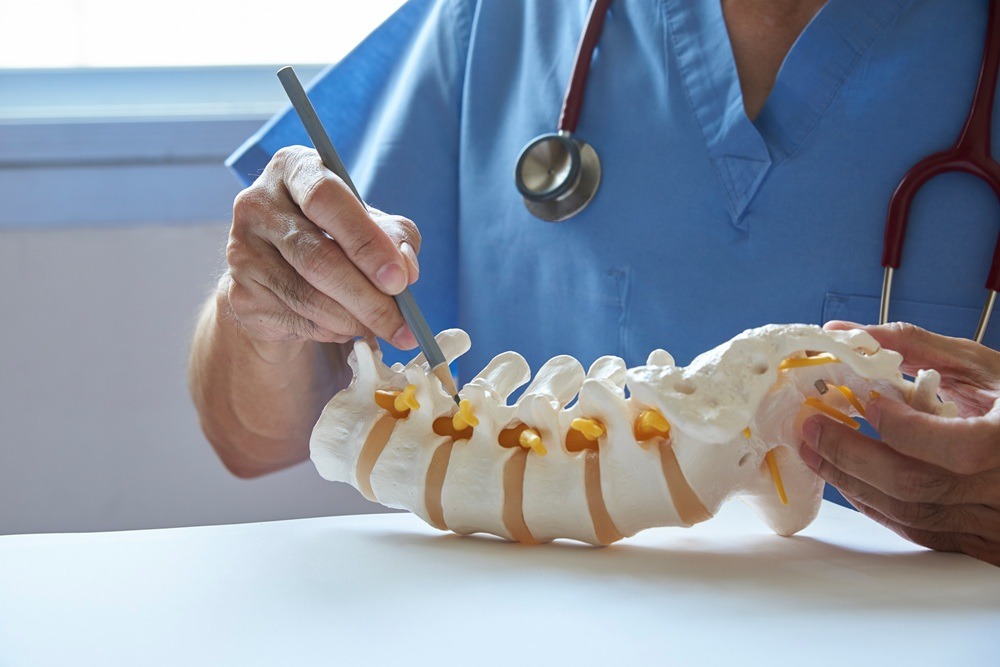
You’ve just emerged from the MRI machine. The doctor reads off the report, describing degenerative changes at multiple levels. Hearing the words “degenerative disc disease” from their mouth triggers anxiety and panic. That’s a normal, understandable response.
The term “degenerative disc disease” sounds like a formal diagnosis. But in reality, it’s often an overly clinical description of a normal middle-aged spine.
A 2025 systematic review published in Medicina analyzed 38 MRI studies involving nearly 2,000 asymptomatic individuals and found that current imaging can’t reliably distinguish normal disc aging from disease.
That means the scan can’t explain why you’re in pain by itself.
Quick Answer
Disc degeneration begins around age 20 and progresses throughout life. By age 50, about 80% of adults show degenerative changes on MRI, rising to roughly 90% after age 60.
Degenerative disc disease refers to degeneration that becomes symptomatic. Pain, reduced function, or neurological involvement define the difference.
Imaging can show structural changes, but it can’t definitively say those changes are the source of symptoms.
What Degenerative Disc Disease Actually Refers To
Degenerative disc disease is not exactly a disease. It’s a condition in which the discs that make up your spine deteriorate. That’s a normal part of aging; it only becomes clinically relevant when it causes symptoms.
Intervertebral discs are built to absorb load, but they operate under biological constraints. They don’t have a direct blood supply. Instead, they rely on diffusion from surrounding tissues for oxygen and nutrients.
That means they get fewer nutrients than other parts of the body. Thus, they repair themselves more slowly, and small structural changes build over time.
Cartilage endplates play a key role in that exchange. As they thin with age, the efficiency of nutrient transport declines, which accelerates degeneration.
How Common Disc Degeneration Really Is
Disc abnormalities are common even in people with no pain.
A meta-analysis of 20 MRI studies found reduced disc signal intensity in 20 to 83% of asymptomatic individuals and disc bulges in 10 to 81%.
In older adults, degenerative findings become nearly universal.
This means the doctors expect to see degeneration in imaging. On its own, it does not explain symptoms or determine treatment. Understanding the common causes of back pain matters here precisely because degeneration on a scan is only one piece of the diagnostic puzzle.
Degenerative Disc Disease vs. Normal Aging: Where the Line Is
Research has not identified a reliable imaging-based way to separate normal aging from pathological disc disease.
The same limitation shows up across both imaging and clinical studies. Degeneration can reflect normal aging, disease, or both. But the scan itself can’t prove which is occurring. For that to happen, symptoms need to exist and match the structural findings.
What Normal Disc Aging Looks Like on MRI
The most detailed imaging-based timeline of disc aging comes from pooled MRI data in asymptomatic individuals.
Between ages 20 and 50, the primary change is biochemical. Proteoglycan levels decline in the nucleus pulposus. Because these molecules attract water, their loss leads to progressive dehydration of the disc.
As hydration decreases, the disc becomes less effective at distributing load. These changes are measurable on advanced imaging but usually do not produce symptoms.
Around ages 45 to 50, regenerative capacity declines further. After age 50, structural changes, including loss of disc height and contour, become clearer.
Degeneration is not evenly distributed. The lower lumbar spine, particularly L4/L5 and L5/S1, shows higher levels of change due to greater mechanical stress.
Genetics plays a major role in how quickly this process occurs. Environmental factors such as heavy lifting contribute less than most people assume.
What Makes Degenerative Disc Disease Different
The presence of degeneration alone is not enough to define disease.
Clinical relevance depends on symptoms, neurological involvement, and functional impact.
Treatment urgency skyrockets when degeneration leads to nerve compression, instability, or persistent limitations in daily activity. In those cases, clinicians base treatment decisions on imaging and clinical findings.
Why Your MRI Findings May Not Match Your Pain
Here’s one of the most useful things for a back pain patient to realize: structural changes and pain don’t track consistently in the spine. The relationship between them isn’t always 1:1.
Two people of the same age can have identical MRI findings, but completely different symptom presentations.
Disc degeneration itself is not inherently painful. Pain occurs when it affects surrounding structures, like nerve roots or adjacent tissues.
One of the more surprising findings in spine research is how disc injuries begin. In a study of 154 patients with new lumbar disc herniation, 66.2% reported spontaneous onset of symptoms. Fewer than 8% associated their symptoms with heavy lifting or trauma.
This challenges the assumption that physical strain causes most disc problems.
Imaging provides structural information. Clinical evaluation determines what that structure means for the patient. This is a large part of why back pain is so difficult to diagnose without a full clinical assessment alongside the scan.
Symptoms That Point Toward DDD Rather Than Ordinary Back Pain
Normal age-related stiffness often improves with movement and worsens after prolonged inactivity.
Patterns that suggest something more include:
- Persistent pain lasting weeks or months
- Pain that worsens with sitting, bending, or lifting
- Reduced range of motion over time
Radiating pain is particularly important. Pain that travels into the leg or arm often indicates nerve involvement rather than isolated disc degeneration. Most herniated discs occur at L4/L5 or L5/S1 and can produce radiculopathy — nerve-root compression that most people recognize as sciatica when it affects the lower back.
Red Flags That Need Immediate Evaluation
Certain symptoms need urgent assessment:
- Fever or unexplained weight loss alongside back pain
- Progressive weakness or motor deficits
- Loss of bladder or bowel control
These findings raise concern for infection, tumor, or severe nerve compression and need immediate specialist evaluation.
How Degenerative Disc Disease Is Actually Treated
The vast majority of DDD cases resolve without surgery.
Conservative care focuses on maintaining activity, strengthening the muscles that support the spine, and correcting movement patterns. Exercises such as planks, bridges, and bird dogs are commonly used.
For patients with nerve-related symptoms, outcomes are often favorable without surgery. Approximately 90% improve within three months using nonoperative treatment. For patients managing related nerve compression conservatively, nonsurgical treatment for a pinched nerve outlines the options that usually come before any surgical discussion.
Doctors and patients only consider surgery when symptoms persist despite conservative care or when neurological deficits are present.
Microdiscectomy is often the first surgical option when a herniated disc compresses a nerve root. It removes only the part of the disc causing compression while preserving surrounding structures.
When It’s Time to See a Spine Specialist
Back pain that improves steadily within the first few weeks rarely requires specialist evaluation. The picture changes when improvement stalls or reverses.
Evaluation becomes appropriate when:
- Pain persists beyond six weeks
- Symptoms worsen or limit daily function
- Pain radiates into the arms or legs
- Neurological symptoms develop
At that point, imaging may be useful in combination with a physical examination. A specialist evaluates whether imaging findings match the symptom pattern and whether they warrant further treatment.
For patients in New Jersey, degenerative disc disease treatment in NJ with board-certified spine specialists provides that combination of imaging review and clinical assessment that the scan alone cannot replicate. When degeneration has progressed to a herniated disc with confirmed nerve involvement, specialist evaluation is where the appropriate treatment path begins.
Frequently Asked Questions About Degenerative Disc Disease
Is degenerative disc disease the same as normal aging?
No. Disc degeneration is a normal part of aging. Degenerative disc disease refers to degeneration that produces symptoms.
Can you have DDD without any pain?
Yes. Many people have disc changes on MRI without any symptoms.
At what age does disc degeneration begin?
Disc changes begin around age 20 and become increasingly common with age.
What is the difference between DDD and a herniated disc?
DDD refers to gradual structural changes. A herniated disc is a specific event where disc material presses on a nerve.
When should I see a specialist?
If symptoms last more than six weeks, radiate into the limbs, or include weakness or numbness.
What the Scan Can’t Tell You
Two people of the same age can have nearly identical MRI findings and completely different levels of pain.
The scan shows structure. It does not determine which structures are causing symptoms.
The difference between normal aging and disease is defined by how the spine behaves over time, not by imaging alone.
Sources
Degenerative Disc Disease — National Spine Health Foundation, 2025
de Vries MHE, Caelers IJMH, van Hemert WLW, Boselie TFM, van Santbrink H. Physiological Ageing of the Lumbar Intervertebral Disc Based on Magnetic Resonance Imaging, a Systematic Literature Review. Medicina. 2025; 61(8):1430. https://doi.org/10.3390/medicina61081430
Lumbar Degenerative Disk Disease — Donnally et al., StatPearls, 2023
Scarcia L, Pileggi M, Camilli A, et al. Degenerative Disc Disease of the Spine: From Anatomy to Pathophysiology and Radiological Appearance, with Morphological and Functional Considerations. J Pers Med. 2022;12(11):1810. Published 2022 Nov 1. doi:10.3390/jpm12111810